
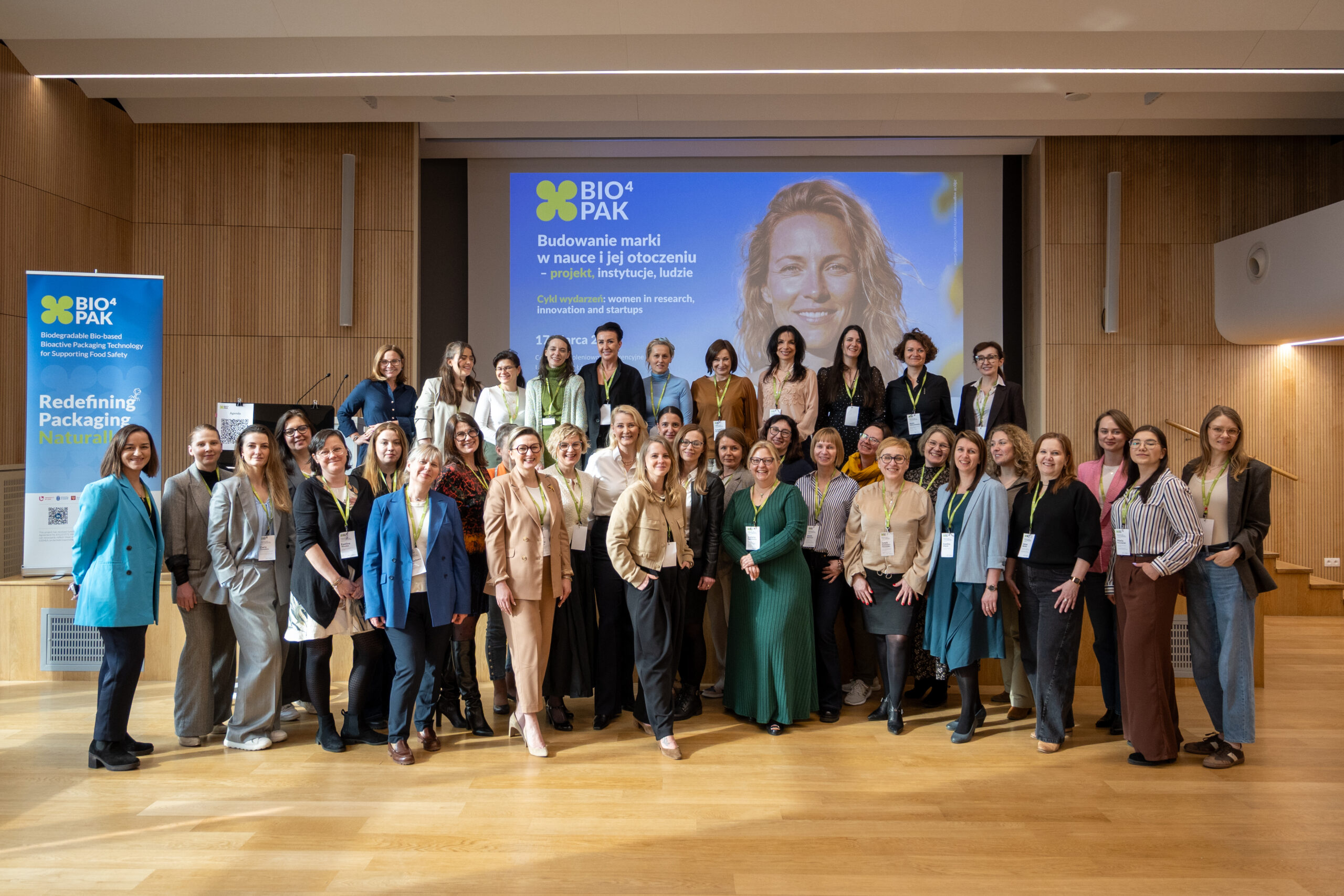
Building connections: over 40 women meet at the first BIO4PAK „Women in Research, Innovation ans Startups” event in Lodz, Poland
17 March 2026
The BIO4PAK project, coordinated by the University of Lodz, hosted the training “Building a Brand in Science and Its Ecosystem” at the Training and Conference Centre of the University of Lodz. The event marked the launch of a new series: “Women in Research, Innovation and Startups.”
The initiative was created to provide a dedicated space for women at the crossroads of science, innovation, and real-world impact — a place to spark dialogue, share experiences, and build meaningful professional relationships, with attention to supporting early-stage researchers in developing their visibility and professional confidence.
Creating space for connection and collaboration
The first meeting brought together over 40 women — researchers, project team members across Poland, business partners, and institutional stakeholders. The strong turnout confirmed the need for initiatives that go beyond formal meetings and create opportunities for authentic interaction.
Blending expert insights with interactive elements, the event also carved out time for networking and informal conversations, recognising these moments as the foundation of long-term collaboration.
This reflects a broader approach within the BIO4PAK project, which emphasises not only scientific excellence but also cooperation and knowledge exchange as key drivers of innovation.
At the same time, the initiative responds to a wider structural challenge. Women still represent only about 34% of researchers in the EU, and even fewer hold key roles in innovation and decision-making. This gap is not only a matter of equality. It directly affects the quality, diversity, and impact of research and innovation in Europe. Strengthening women’s visibility and professional presence is therefore not only an individual development strategy, but a systemic necessity.
Branding in science: from projects to ecosystems
The programme opened with a session dedicated to branding understood across three levels: project, institutional, and regional.
Karolina Rudnicka, BIO4PAK Project Manager from the Faculty of Biology and Environmental Protection at the University of Lodz, spoke about how a project’s brand can build a shared narrative and a vision for implementation — long before any product exists.
This was followed by Katarzyna Liberska-Kinderman, Director of the Centre for External Relations and Social Responsibility at the University of Lodz, who presented how the University has been shaping its brand identity beyond visual elements.
The regional perspective was introduced by Renata Biadała from the Department of Entrepreneurship and Just Transition at the Marshal’s Office of the Lodzkie Voivodeship, who discussed the image of the Life Science sector in the region and its future development.
Speakers highlighted that in the context of research and innovation, a brand is not merely a visual element. It is a structure that:
• organises how teams think and communicate,
• clarifies scientific and societal value,
• and enables a coherent voice toward partners, stakeholders, and society.
Without a consciously developed identity, of a project, its leaders, and its team, research initiatives often remain invisible beyond their immediate consortium.
This is especially crucial for bold, future-focused projects like EIC Pathfinder, where outcomes are uncertain and timelines long. Here, a strong brand offers a steady anchor, making the vision accessible, the path clear, and progress feel real.
From knowledge to personal development
The event also spotlighted personal branding, acknowledging its rising significance in research. Empowering women to build their own brands amplifies not just their voices, but also the strength of their teams and projects.
During the workshop, Agnieszka Martyna-Ross, a trainer with over 15 years of experience in professional image and personal branding, equipped participants with practical tools to shape their professional identity and communicate their work effectively.
Yet, some of the most valuable moments unfolded beyond the formal programme.
Informal conversations, shared experiences, and moments of mutual understanding created a space where participants could openly discuss challenges, ambitions, and opportunities. These interactions highlighted the importance of community-building in research and innovation environments.
First step in a larger journey
This gathering reached beyond branding. It was about building connections that can lead to future collaborations, joint initiatives, and stronger support networks.
As the opening chapter of the “Women in Research, Innovation and Startups” series, this event set the foundation for a growing community of women determined to shape their place in science and innovation.
Further meetings in the series will continue to develop this space — combining knowledge-sharing, skill development, and networking opportunities.
In line with European priorities, closing gender gaps and fully mobilising the available talent pool is not only a matter of fairness, but a key condition for strengthening competitiveness and innovation capacity.
 Link to gallery: https://flic.kr/s/aHBqjCNsCB


 using WordPress and